

AI can make a recruitment agency faster at almost everything, including spending two weeks on a job nobody has approved. Before buying more speed, follow one vacancy through the business and find out what is actually holding it up.
Dan Cartwright · Recruitment Web Design, powered by ScopeSite – Newsletters designed for leaders in UK recruitment.
The word received
Before you buy another piece of recruitment software, apply for a job through your agency. Use your phone, away from the office, with somebody talking beside you and somewhere else you need to be. The candidate you would like to attract may have similarly unreasonable demands on their attention.
Identify a plausible vacancy, read the description and upload a CV. Then, if the website asks you to type the CV contents into another set of boxes, consider what the upload was for. You have supplied your employment history. The website has accepted your employment history. It now wants you to prove that you know your employment history, presumably in case you uploaded somebody else’s for a change.
Eventually you press the button, and a green tick appears, with the word 'received' next to it.
I would like to know who received it.
A consultant with the vacancy open and enough information to do something useful? A shared inbox nobody has checked? A database that has accepted a row but has no opinion about whether the attachment arrived with it? These are different events, although a sufficiently agreeable interface can make all of them look equally successful.
The candidate sees a promise. Inside the business, there may have been nothing more significant than a successful transfer between two computers, one of which now considers the matter closed. Should the transfer to the consultant fail, the candidate will have to discover the truth by waiting, which is quite a lot of unpaid software testing to demand from someone who wanted a job.
This is why I struggle with discussions about whether artificial intelligence will destroy recruitment. We can become tremendously interested in what an unfamiliar machine might do next year while remaining oddly relaxed about what familiar machinery failed to do this morning. The future gets a strategy meeting; the missing application gets another spreadsheet if anybody notices it is missing.
I worked in recruitment before I started building websites and systems, so I have reasons to be suspicious in both directions. I understand why an owner wants less administration, and I also earn my living building some of the things that promise to remove it. That gives me a commercial interest in the answer involving software. It should also oblige me to ask whether software is the answer before producing a proposal.
Sometimes it will be. A reliable handover, an accurate public vacancy and a notification that reaches the right person can spare people a great deal of repair work. Sometimes, however, the missing component is a decision nobody has made, and adding another application simply gives the indecision somewhere more expensive to live.
Suppose AI could write every advert tomorrow. What would still delay a placement? Once it had summarised every CV, who would establish whether the summary described the candidate? If it could send the follow-up automatically, had anybody decided what the follow-up ought to say beyond asking whether the recipient had read the previous one?
Those questions are less impressive than predicting the end of employment, but their answers tell you whether you are removing work or furnishing it with a subscription. Recruitment involves commitments between people, and a system can describe a commitment much more easily than it can obtain one.
The client needs to mean the salary. The candidate needs to understand the arrangement. Somebody needs to notice when a small alteration makes the whole thing unsuitable. I would start by finding out where those commitments become uncertain, preferably before the uncertainty acquires permission to send emails.
The busiest job nobody approved
Consider a hypothetical engineering vacancy. The hiring manager is enthusiastic, the agency knows the specialism, and the brief looks close enough to previous successful assignments to justify getting started. There is a budget question, but the client says it should be fine, which is an encouraging sentence until you need to establish who is doing the encouraging and whose money is involved.
By Wednesday the vacancy has an advert, a search, candidate conversations and a respectable position in the weekly meeting. By Friday somebody is preparing an update about the progress made on the search. The following week requires another update, partly because the first one has prompted questions, and by the end of the fortnight the vacancy has generated enough correspondence to suggest that it is a substantial part of the business.
Then Finance declines the hire.
The agency has done real work. Candidates have given real time. The only imaginary component was the client’s authority to employ somebody, which turned out to be rather important to the transaction.
Now add an AI assistant. It can help prepare the advert, organise correspondence and produce updates, allowing the team to work through this unfortunate fortnight with greater speed and much better spelling. The approval still has not arrived. An activity report might look healthier while the commercial position remains unchanged.

I would rather buy a system that makes the missing approval difficult to ignore. That requires the agency to decide what counts as approval, who can give it and when sourcing should stop pending an answer. Finding the word 'approved' in a forwarded email is a rather different achievement, particularly when the email says the manager expects it to be approved next week.
The wider market gives owners plenty of reasons to care about that distinction. The September 2026 KPMG and REC report recorded a slight improvement in permanent placements in August, the first since September 2022, alongside a fifth consecutive monthly rise in temporary billings. Overall demand for staff was still falling and candidate availability was rising. These survey indicators describe movements reported by consultancies, rather than percentage changes in the number of jobs.[1]
That combination is perfectly possible. An agency can finish assignments already under way and have a better month while new instructions remain thin. A recovery headline cannot tell you whether the finance director at your largest client has signed anything, however enthusiastically somebody forwards it around the office.
The ONS September release estimated 702,000 vacancies for June to August, down 4.9 per cent on a year earlier but broadly flat since the beginning of 2026. The small quarterly fall was within the survey’s uncertainty. The REC’s September JobsOutlook also reported improving employer confidence, although the balances for the economy and hiring remained negative.[2][3]
There is reason to look for improvement without pretending every pleasant conversation has become an order. Confidence belongs in a survey; an approved assignment needs a person, a budget and a decision. An agency that confuses those things can spend a busy month financing other people’s intentions.
The dashboard needs the same discipline. An accepted offer, a start date, an invoice and cleared funds are different stages, despite the temptation to give them all the same reassuring colour. Follow the money far enough and the distinction becomes easier to appreciate, because wages tend to require money rather than an encouraging probability.
Permanent recruitment and contractor supply have different timing problems, so the useful view must fit the desk. Include assignments that consumed time without producing a fee, disputed invoices and the work needed to repair a client relationship after something went wrong. A report containing only successful placements has already removed part of the cost of making them.
Much of the missing cost may be sitting with a competent consultant. They remember that the salary changed, ask the additional question and check the attachment everyone else assumed was there. Their intervention prevents the failure, so the failure never appears in the report, while the intervention appears to be an administrative step someone might automate away.
That is a dangerous misunderstanding of efficiency. Remove the necessary judgement, and the saved minutes may return as a dispute. Leave every workaround untouched, and you employ skilled people to carry information between systems purchased to carry information between systems.
Before buying speed, I would ask the consultant which parts of their day protect an assignment and which parts repair the machinery around it. The answer is likely to be more useful than another presentation about how many tasks a model completed while the presenter made coffee.
Before we retire from the entire profession
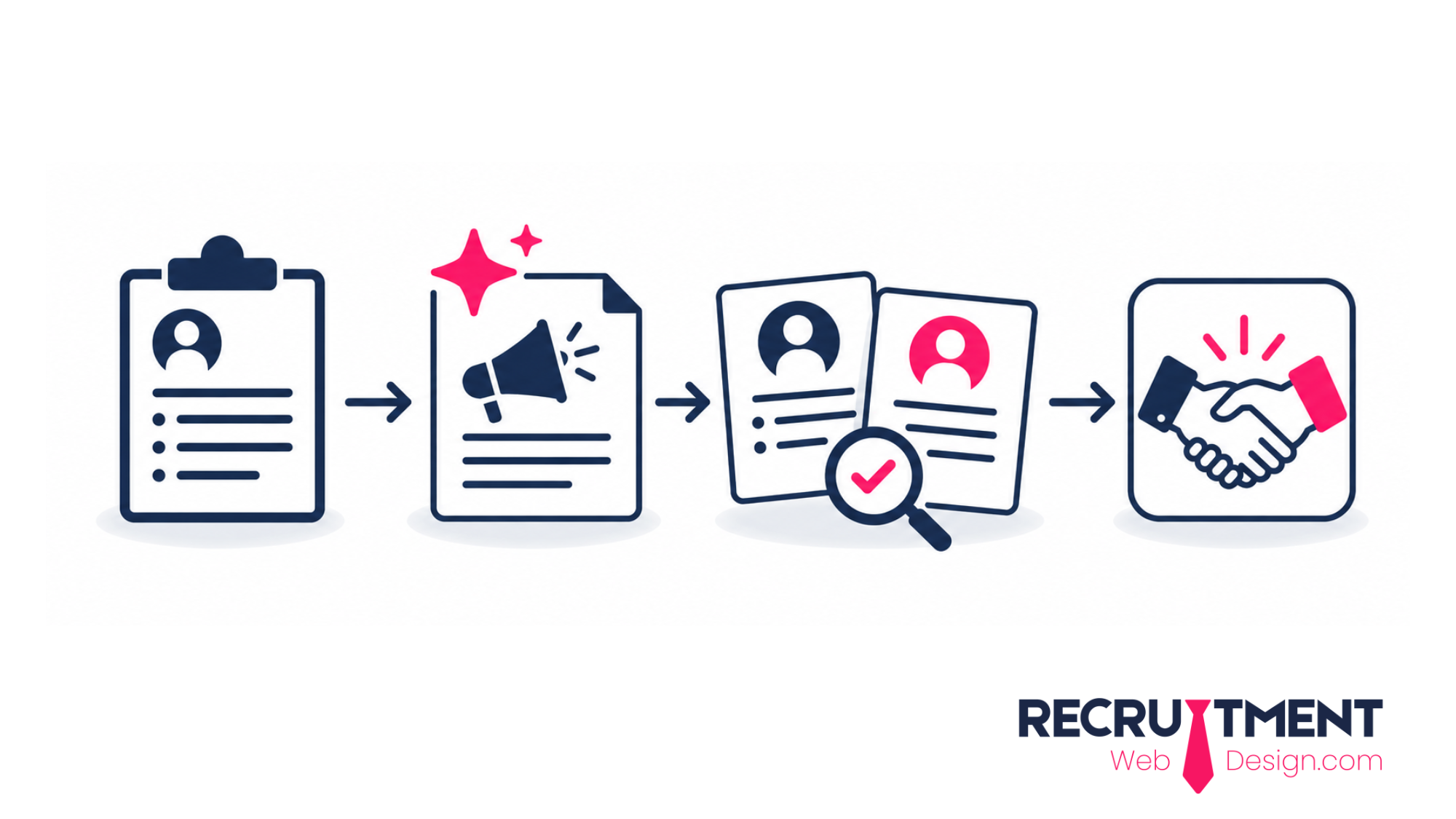
An advert appearing in seconds proves that an advert can appear in seconds. Turning that demonstration into the disappearance of recruitment requires several other developments, including clients who understand their requirements, candidates who understand the offer and somebody accepting responsibility when the two turn out to have understood different things.
I am happy to examine that argument. I would prefer to see the missing stages before we start clearing the office.
The ILO’s 2025 exposure index estimated that roughly one in four workers worldwide held occupations with some exposure to generative AI. It assessed potential effects on tasks, rather than counting redundancies, and considered changes within occupations more likely than wholesale replacement.[4]
That is a useful distinction, although it provides no guarantee that an agency can carry on unchanged. If clients can complete more work with fewer people, they may alter hiring plans. If a supplier makes part of the agency’s service cheaper to reproduce, the agency will need to explain the value of the rest. The word relationships cannot be expected to settle every commercial objection indefinitely.
The Bank of England’s July 2026 business intelligence recorded reports of AI-related productivity gains alongside reduced demand for some junior and administrative roles, including graduate recruitment. Those were qualitative reports from business contacts, with weak demand and labour costs also influencing decisions. They were not an economy-wide causal count of jobs removed by AI.[5]
For an owner, that suggests a practical conversation with clients. Which tasks are they keeping in-house? Which responsibilities have been combined? Does the familiar job title still describe the same work? Otherwise the agency may be running an excellent saved search for an organisation that has changed around it.
There is a similar question about learning inside the agency. Experienced judgement develops through encounters with real work, including the small mistakes a colleague catches and explains. If software removes the task entirely, the business needs another way to provide the lesson. It would be a peculiar training strategy to remove the opportunities to learn and then complain that nobody coming through has any experience.
I would use the technology to make those conversations easier. A junior could compare a draft with the original brief, identify what the model assumed and discuss why an experienced consultant rejected a superficially convincing recommendation. That is a proposed use worth testing. Passing on every polished answer and hoping judgement develops through proximity to the screen seems less promising.
There is substantial evidence that assistance can help some workers on some tasks. A published study of 5,172 customer-support agents found an average increase of 15 per cent in issues resolved per hour, with larger benefits for less experienced workers. That is evidence from customer support, rather than a forecast for recruitment agencies or a guarantee about whatever product is being sold this month.[6]
Another experiment, involving 758 consultants using an earlier GPT-4 system, found improvements on tasks within the model’s capabilities and worse accuracy on a task outside them. The important lesson is the unevenness: being useful on one assignment did not establish competence on the next.[7]
A recruitment business has an additional reason to take that seriously. Persuasive writing is part of what it sends to clients. When the language improves, an unsupported statement can become harder to spot, because the sentence now looks like something a capable colleague might have written after checking.
This is why I would evaluate a task rather than appoint AI to an imaginary job description covering the entire office. Drafting an advert from an approved brief, extracting a stated notice period and deciding whether a person’s experience supports a client recommendation involve different evidence and different consequences when the answer is wrong.
Some work does not need generation at all. A receipt can be triggered by a successful application, a calendar invitation can go to the correct people and a vacancy can close when its underlying record closes. Those are useful jobs for ordinary automation. I see no reason to make the calendar develop opinions before allowing it to book an interview.
That distinction can be commercially inconvenient for people selling new systems, including me. It may reveal that the needed improvement is already available in software the agency owns, or that a clearer field and an agreed process would do more than another subscription.
Where producing or reorganising language offers a benefit, test it. Keep the output linked to the information that supports it, and allow the system to leave something unanswered. The moment a fluent guess becomes the official record, the next person is liable to treat it as evidence.
The salary changed in one of the systems
Take a salary amendment in our hypothetical agency. The client approves a new figure by email and the consultant updates the vacancy record. The advert was copied yesterday, the website gets an overnight feed, and the candidate pack is in a document whimsically named "final."
The agency now has several salaries in circulation, all attached to the same job. Each version has a plausible explanation for being there, and none needs a malicious person to create it. The person working from the candidate pack may be every bit as conscientious as the person working from the updated record.
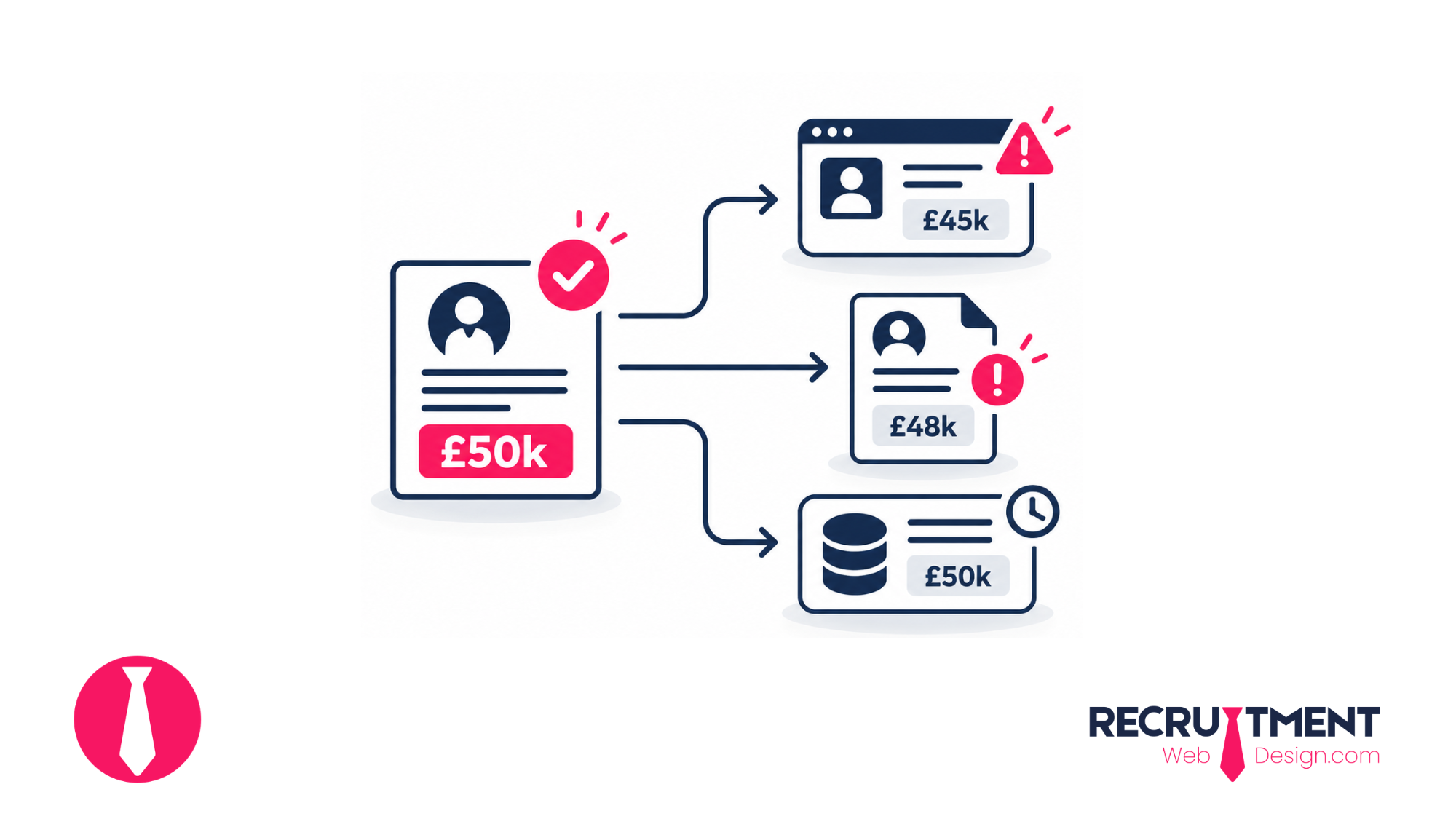
Add a tool that summarises the correspondence and the problem becomes more interesting. The latest email might contain the approved amount, a proposed amount or a manager asking whether the approved amount can be changed. A model can help organise those possibilities. The agency still needs to decide which record carries authority and how that authority is established.
I want the approved figure to have a source, an owner and an effective date. I also want to know where a change must travel, including any candidate who has already been told something different. Keeping the previous version is useful when explaining an earlier conversation; leaving it indistinguishable from the current version is less helpful.
The same journey can give a candidate a promotion. Suppose their CV says they supported a migration project. A generated summary describes them as the project lead, the submission inherits the description and a later database search finds them under leadership experience. By the interview, several people may believe the claim, while the candidate has done nothing more ambitious than upload the original CV.
The ICO’s agentic-AI work identifies the risk of plausible but inaccurate information cascading through connected tools and databases. In recruitment, the practical concern is that an unsupported description can be repeated until the repetition looks like corroboration.[8]
A reviewer needs access to the source, rather than another summary of the summary. Unsupported fields should stay unresolved until someone can establish the answer. I would much rather ask a candidate who led the project than explain to a client why our submission had reorganised it retrospectively.
Corrections must follow the same route as the error. Amending a note does not correct the document already sent to a client or the impression in a colleague’s head. You need to know where important information went, who received it and what must happen when it changes. Otherwise the central database becomes accurate while the business continues discussing the previous version.
That is also a useful way to examine a supplier. Owning the records means rather less when you cannot see how they move, identify a failed transfer or export them in a form another system can use. The ownership clause deserves reading, but so does the error log.
For a demonstration, I would bring a deliberately awkward test record and ask what happens when the next step fails. The usual demonstration has been given every advantage: complete information, suitable permissions and a presenter who knows where to click. Your Tuesday may contain an absent approver, an attachment in the wrong format and a client who replies to an old email because it was nearest the top of the inbox.
Show me whether a failed transfer remains pending, who receives the alert and how that person puts it right. Then show me what happens if they try again. A recovery process that sends the same submission twice has introduced another job for the consultant, who will now explain why the agency is so enthusiastic about this particular candidate.
This does not automatically justify replacing the applicant tracking system. The fault may be a field, a connection or a notification going to somebody who no longer works there. A small repair around the existing system may be enough; replacement earns its place when the constraints justify the cost and disruption of moving.
The website belongs in this examination because it publishes the agency’s promises. A candidate needs to understand the work and apply. An employer needs to see relevant expertise and discuss a brief. Sending both through a generic contact form leaves somebody inside the business to sort them out, which may be perfectly manageable, but it is still work and should not be mistaken for a finished journey.
For job listings, Google requires structured data to match the visible vacancy information and sets out ways to deal with expired roles. Meeting its requirements makes a listing eligible for the job-search experience, without guaranteeing display.[9]
An owner need not memorise the markup to ask whether the role is current, whether the public salary agrees with the approved record and whether the application reaches the right place. Those questions should survive the homepage unveiling. The photograph can be excellent, and the application can still arrive at an inbox belonging to the person who approved the photograph last year.
I would regard a working handover as part of the website, rather than a mysterious operational matter beginning just beyond the edge of the design contract.
Everybody has written a magnificent CV

There is another reason to try your own application process. CV-Library’s September 2026 Candidate Behaviour Barometer found that roughly seven in ten candidates reported abandoning lengthy or complicated applications, while 96 per cent of hiring respondents considered their processes reasonably efficient. These were separate samples of candidates and hiring professionals, not opposing accounts of the same applications. [10]
The gap is still an excellent reason to get your phone out. An internal view can make a process look straightforward because everybody inside already knows where the documents go, what the field means and whom to ask when it breaks. A candidate has none of those advantages and may be doing this after work, when the website’s desire for a separately typed employment history is less endearing.
The same survey found that 69 per cent of hiring respondents believed AI-generated applications made strong candidates harder to identify. That records a difficulty reported by the respondents; it does not establish that a polished application is false.[10]
When every application is beautifully written, polished language tells a recruiter rather less about who has actually done the work.
Someone can be good at their work and poor at explaining it. Assistance with language may help them show real experience more clearly. Inventing the experience remains a separate problem. An agency should be wary of creating a test in which candidates must write professionally, but leave enough awkward wording to reassure the reader that they did it without help.
Nor can every crowded inbox be explained with a single accusation against AI. Ashby’s September report found that applications per hire had doubled across its EMEA customer dataset between 2021 and the first half of 2026. Its account of AI’s contribution was qualitative, rather than a measured causal share of the increase. The same report described broadly stable time to hire and stronger recruiter output in that sample, so it does not support a simple story of universal collapse.[11]
More applicants, fewer opportunities and easier applications can all contribute to workload. The owner needs to know how completed forms become relevant candidates, and how those candidates become people who still want the role once the arrangement has been explained. Counting forms is easier, but eventually a client expects someone to start work.
I would be careful about the target given to the team. Reward messages sent and the system can help produce more messages. Reward viable conversations and it must preserve the information needed to recognise one. A longer shortlist can leave the client with more reading and no better understanding of whom to hire.
Imagine receiving three submissions describing commercially minded leaders with excellent communication skills. The language is immaculate, but it remains uncertain whether any of these people has dealt with the actual problem in the department, which might be an unhappy team, an unreliable reporting process or a project whose previous leader left everything in a folder labelled handover.
I would ask for evidence about relevant work. What decision did the candidate make, what information did they have and what changed afterwards? Keep the exercise proportionate, make permitted assistance clear and provide appropriate access arrangements. Asking someone to perform an unpaid client project over the weekend should not become acceptable merely because the invitation calls it an assessment.[17]
The consultant then needs to distinguish the candidate’s account from what has been checked. A useful summary can organise both, provided it preserves that distinction. The client should be able to see why the agency is making the recommendation, including where uncertainty remains.
That is also part of the answer when the client asks why they should pay an agency while having access to similar tools. Access to a text generator is a difficult thing to defend as specialist value. Understanding the brief, challenging assumptions, checking evidence and maintaining confidence through a difficult process give you more substantial work to explain.
Saying relationships is unlikely to be enough when the relationship consists of an automated greeting followed by another automated greeting enquiring about the first. A good update gives somebody useful information. Preparation is valuable when it lets the consultant listen properly. The service needs to show what happened because a capable person had the time and evidence to act.
Picture a candidate who has interviewed, arranged time away from work and been told to expect feedback. Inside the agency, the interview task is complete. At home, they are still checking their phone. An honest message saying the client has not decided will not resolve everything, but it will stop the silence requiring its own explanation.
I want automation to help deliver that message, and I want the business to count the work as useful even when it creates no impressive new total for the weekly report.
Who is actually making the decision?
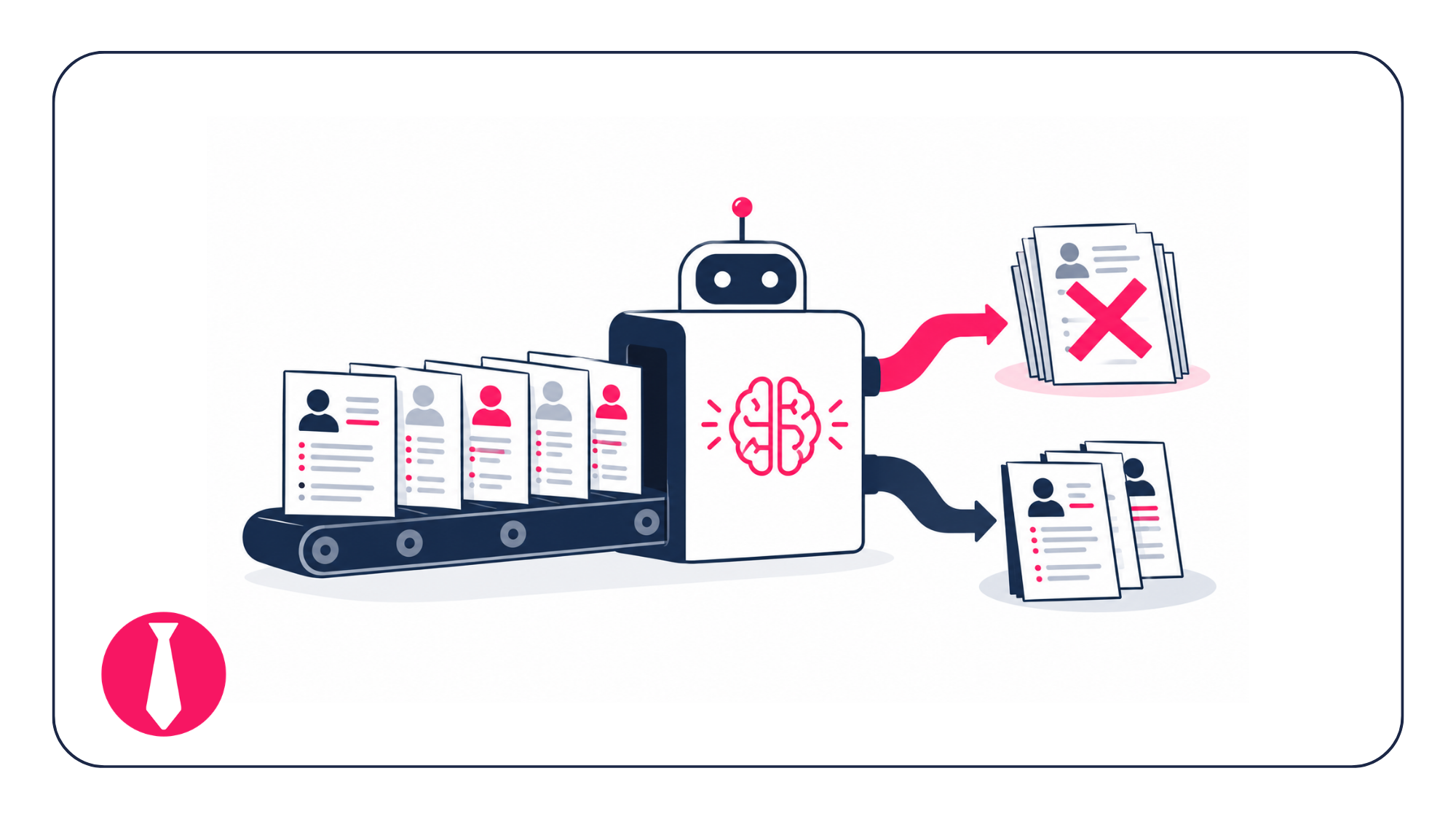
Now consider the candidate who never gets as far as an interview. A system gives them a low score, they disappear from the shortlist and the hiring team interviews the survivors. Everyone involved can truthfully remember speaking to people, which does not tell us who considered the people removed before those conversations began.
The ICO’s 2026 recruitment work examined this problem through voluntary engagement with employers. It found examples described as decision support where people were effectively accepting the system’s judgement, including attention concentrated on high-scoring candidates while lower-scoring ones received little examination.[12][13]
A human interview at the end cannot retrospectively examine an earlier exclusion. If meaningful human involvement is part of the design, it must be real at the relevant decision: the reviewer needs evidence, competence, time and authority to alter the outcome before it is applied. Clicking through a screen can record a decision without demonstrating that anybody considered it.[13]
I would be particularly sceptical of an arrangement in which the reviewer is encouraged to agree with the machine quickly, but must complete an explanation whenever they disagree. Even a competent person needs a process that permits judgement. Putting a human name at the bottom does not resolve that management problem.
The legal position also needs care. The updated UK framework permits significant solely automated decisions in circumstances subject to conditions and safeguards. This does not mean every automated recruitment decision is allowed, or that a supplier can make every use acceptable by adding an approval button. The particular deployment needs a proper assessment against current requirements, with appropriate data-protection advice for the agency’s actual process.[12]
Candidates need a usable route through those safeguards. Explain where automated decisions are being made and provide the required information about them. Make it possible to raise a concern, contest an outcome and obtain human intervention where applicable. An email address only helps if somebody owns it, understands the request and can arrange a genuine response.[13]
That belongs in the operating process before launch. So do risk assessment, any required data protection impact assessment and a plan for checking fairness and performance over time. Passing the first trial does not remove the need to investigate later patterns, especially if certain groups or kinds of experience are consistently being missed.[13][16]
The ICO’s 2024 provider audits found issues including excessive data collection and inappropriate filtering or inference involving protected characteristics. Those findings concerned the tools examined, rather than every recruitment system. They give owners specific risks to examine without turning the whole subject into a vague argument about whether computers are trustworthy.[14]
There is a simpler privacy question as well: where is the CV going? Removing a name does not necessarily make it anonymous. Work history, location and other details can identify somebody in context, so an apparently minor act of dragging a document into another service may disclose personal information.[15]
I would expect the agency to know which services are approved, what they retain, what purposes they use the information for and who can access it. Supplier terms and processing arrangements deserve attention before a useful experiment becomes an office habit. Paying for an account answers the billing question; there are several other questions on the desk.[16]
Accuracy and authority need separate consideration. A draft submission that faithfully describes the candidate can still cause harm if it is sent to the wrong recipient. Giving software permission to prepare text differs from giving it permission to act on the agency’s behalf, however small the distance between the two buttons looks on screen.
For a controlled trial, I would usually begin with clearly bounded work: drafts that wait for approval, uncertainty that remains visible and failures that leave an item pending. The right design depends on the task, but I want the person responsible to see what happened and what still needs doing.
Then test the awkward events. A candidate withdraws while the submission is being prepared, the client changes the recipient or the same application arrives twice. What happens when the approver is absent? If every exception returns to a person, count that person’s work, and make sure the exception actually reaches them.
The government’s responsible-AI recruitment guidance supports a practical assurance process: define the need, examine supplier evidence, test in the intended setting and monitor performance. The useful question is what evidence supports this use in your business, rather than whether a product has passed one impressive demonstration somewhere else.[17]
Different failures also deserve different responses. An awkward sentence in an internal draft is repairable in a way that a false salary, an inappropriate disclosure or an unsupported rejection may not be. Agree the important failure conditions before the trial produces results, while everyone can still discuss them without defending something they have already bought.
This is a reasonable burden to place on procurement. The supplier is asking to become part of a process involving people’s employment and the agency’s reputation. I would expect a better answer than a reassuring adjective and a padlock icon.
Where the saved afternoon went

The part of a software demonstration I most want to see often begins after the presenter stops the timer. The advert has appeared, but someone must check the salary, remove an invented benefit and ask the client what an abbreviation means. The finished output is still some distance away, although the saving has already made it onto the slide.
For a trial, define the task from the point at which the team actually receives the information to the point at which the result is checked and usable. Include missing inputs, corrections and later repair. Then compare similar assignments, rather than giving the model a tidy brief and setting the manual process the one that has been upsetting everybody since Wednesday.
Keep failed attempts in the results. A person who abandons a generated draft and starts again has done work, even though the abandoned draft may be absent from the folder selected for the demonstration. I would also ask where the effort went: a faster internal step that creates additional checking for the client may have moved the burden rather than removed it.
METR’s developer-productivity research provides a useful warning about measurement. Its February 2026 update explained why selection and time-recording problems made later estimates unreliable. Its earlier finding of a slowdown should therefore not be presented as a dependable statement about current AI use. This is software-development research, with a methodological lesson rather than a recruitment productivity forecast.[18]
Ask people whether a tool helps, then examine the complete work alongside their impressions. A very quick draft can feel like the whole saving because generating it is the conspicuous part. Checking it can feel like ordinary work because checking things was already part of the day.
Use a simple hypothetical calculation. Suppose thirty tasks a week currently take ten minutes each, making five hours. A new process takes four minutes per task, apparently returning three hours. Add ninety minutes for checking exceptions and maintaining the workflow, however, and the total effort becomes three and a half hours. The net saving is ninety minutes, before setup and training.
Ninety minutes can be valuable. It is worth knowing that it is ninety minutes before promising somebody an afternoon.
The accounting needs equal restraint. Time returned to a salaried consultant creates capacity; it does not automatically remove a cost from payroll. That capacity might support another assignment, improve candidate care or allow the consultant to finish on time. A cash saving requires a cost actually to fall, and additional revenue requires a commercial result. The same recovered hour cannot be both a reduced staffing cost and an extra hour sold somewhere else without explaining how that happened.
There are costs around the task too. Subscription fees, usage limits, integration changes, training and ongoing maintenance belong in the decision. Find out who repairs the workflow when something changes and how the information is recovered when the supplier relationship ends. A monthly price describes one part of owning the process.
For the actual test material, I would include the cases people find awkward. A brief with conflicting locations, an unstated salary or a candidate whose unfamiliar title conceals relevant experience gives the trial something useful to reveal. Agree beforehand whether a good output should ask a question, leave a field unresolved or stop entirely.
The reviewer needs the original material and a clear standard. Record omissions as well as inventions, keep track of complete restarts and look for patterns across task types. Have somebody other than the enthusiastic pilot owner examine a representative selection, including failures, so the assessment does not depend on the judgement of the person most invested in a good result.
Staff must also be able to report mistakes without becoming the office opponents of progress. A consultant who finds a serious problem has improved your information about the tool. Suppressing that information may make the pilot report more attractive, but it is an odd way to buy reliability.
Then decide what the released time is for. Otherwise the easiest destination is more of whatever the dashboard already counts, and the consultant discovers that the reward for removing a task is a larger target for the tasks that remain. Resistance to that arrangement need not indicate a poor understanding of technology. It may indicate a very good understanding of the arrangement.
There are worthwhile alternatives. Clarify a brief before sourcing, discuss a difficult recommendation with a junior or give candidates the feedback the client has delayed. Ask the people doing the work what they spend time repairing and what they would do if that repair disappeared. The answer may identify the best trial more reliably than starting with whichever feature produced the loudest reaction in the sales meeting.
I would also count going home on time as a possible benefit. It needs to be an intended, observed outcome rather than a convenient claim after the figures disappoint, but a tool that removes unnecessary evening work has done something useful. Every saved minute need not be dressed up as additional revenue to justify its existence.
Somebody still has to ask about the travel

Return to a second version of our hypothetical engineering vacancy, this time with the budget approved before the agency starts searching. The client needs experience with particular equipment, a workable commute and availability reasonably soon. There is also occasional travel, which everyone has accepted because it sounds like the sort of detail that can be dealt with later.
Later arrives when suitable candidates start asking where they will be sleeping.
The agency can improve the advert, examine more records and prepare a better update while the hiring manager continues asking why nobody has been found. Each action may be competent. None will establish what occasional means, or whether the approved salary buys the combination of experience and travel the client has in mind.
A useful AI-assisted process could assemble the unanswered questions, put the brief beside the later correspondence and show the consultant where the accounts differ. It could prepare a draft request for clarification. That gives a person something concrete to take to the client, which is considerably more useful than another beautifully written description of an unresolved search.
Someone with authority still needs to answer. If the delay is caused by reconstructing information, software may help. If everyone understands the question and the person entitled to decide will not decide, the agency has reached a different kind of problem. I would record that distinction rather than allowing the search to remain active merely because activity remains possible.
Suppose the client finally clarifies that the travel means two nights away most weeks. The title and salary have not changed, but the role has changed for a candidate organising life around them. The original adjective allowed everyone to picture a different week. The answer now gives the consultant an arrangement they can discuss honestly.
The system can help identify people whose recorded preferences appear compatible, subject to the agency’s permissions and checks, while leaving room for those preferences to have changed. A note made during an earlier search records a conversation at a point in time. It should not settle what somebody is willing to do now.
Some candidates may decline, and the shortlist may shrink. That can still be progress. People have been spared a process leading towards a job they could never accept, and the client has learned something about the market for the requirement it actually wants fulfilled.
This is part of the professional value I would want an agency to defend. There is work in asking the uncomfortable question, obtaining an answer, explaining the consequences and giving a client a recommendation they may not enjoy hearing. Generating more names can sometimes postpone that conversation while creating the appearance that it is being addressed.
Perhaps the package needs to change. Perhaps the travel can be shared differently. The manager may refuse both, and no system can guarantee that useful information will be welcomed. What it can do is preserve the answer, put it in front of the right person and prevent the team repeating work that depends on an unresolved decision.
For an owner considering AI, I would start there: one assignment, followed through with the consultant who handled it, including the unofficial repairs and the assumptions that survived because everyone thought somebody else had checked. Choose a trial around the obstruction you find, define a useful result and give someone authority to stop the trial if it fails.
Then make sure the system’s account of the work agrees with the people experiencing it. Received should tell the candidate something reliable, approved should identify an actual decision, and complete should mean the promised work has been done. Those are modest ambitions for software, although they would improve quite a few demonstrations.
Our engineering vacancy can now wait for the hiring manager to alter the requirement, change the package or leave it unfilled. The consultant has recorded the decision needed and told the people affected where things stand. The system could still send another hundred emails, but the search is paused and the status is amber, which will have to do until somebody answers the question.
Have a poke around
You have just read several thousand words telling you to be suspicious of software demonstrations.
It would therefore be slightly ridiculous to finish by showing you a screenshot and asking you to admire it.
So don’t.
Recruitment Web Design has live interactive demos you can actually use. Open them, click around, try the journeys and see how a recruitment website can handle candidates, employers, vacancies and the machinery underneath them when those things have been designed as part of the same system.
No booked presentation required. Nobody hovering over the mouse, waiting to steer you away from the awkward button.
Have a poke around.