
By Dan Cartwright (Connect On LinkedIn) | 19 September 2026
The useful automation, the expensive mistakes and the decisions facing an agency owner whose business still depends on somebody accepting a job.
Suppose a company needs a finance manager. There is a backlog, the reporting is a mess, and whoever gets the job will inherit a spreadsheet whose most important formula was written by somebody who left without explaining it.
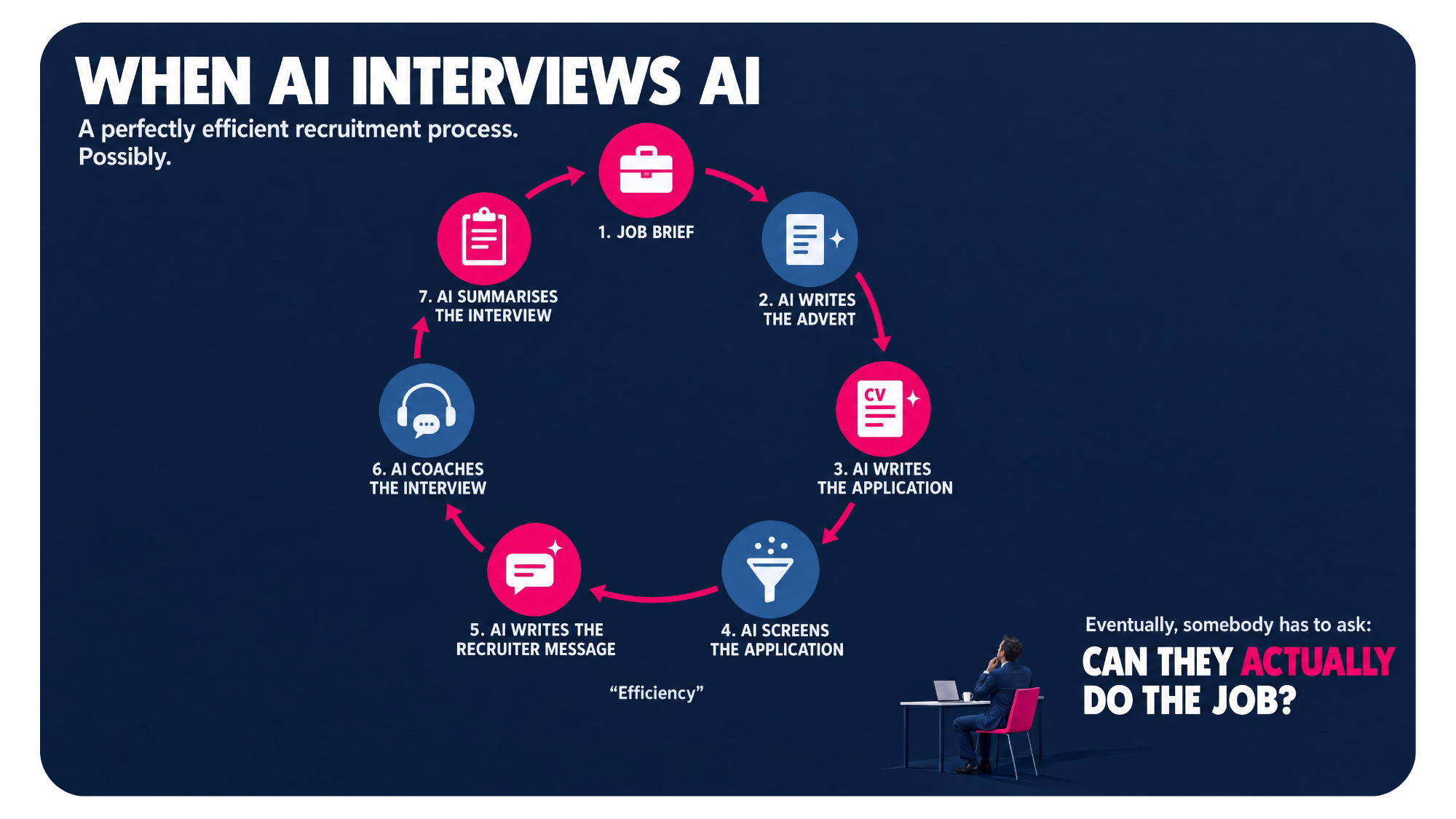
The company asks software to improve the job description. Out comes an opportunity for a strategic finance professional to support an ambitious business. A candidate asks different software to improve the application and discovers that they are, by an extraordinary coincidence, a strategic finance professional seeking an ambitious business. A screening system compares these two magnificent documents and finds considerable agreement.
The spreadsheet remains unexplained, although it is now surrounded by people with excellent communication skills.
That imaginary example captures my concern about AI in recruitment. The machinery can help with the work around a decision, and some of that help is excellent, but it can also manufacture a convincing appearance of progress. Everyone gets a better document. The employer still needs someone who can untangle the accounts without resigning before lunch.
There are already real products for assisting with sourcing, candidate evaluation and outreach, while employers such as HMRC have published advice about applicants using AI. The ingredients exist on both sides of the desk, and what matters is how you combine them. (LinkedIn Hiring Assistant; HMRC application Q&A)
For an independent recruitment owner, this is an awkward time to be offered a tidy answer. One camp says the profession is finished, another insists that relationships make it untouchable, and both seem remarkably certain about the future employment prospects of people they have never met.
I would trust neither with your staffing plan.
There is useful work for AI in this picture. Let it organise the information, prepare the material for a conversation and help find the relevant person whose record is buried under years of inconsistent job titles. I have no desire to preserve avoidable administration as a national craft. But the same technology makes persuasive language cheap, which creates a problem for any hiring process that has been treating it as evidence of something else.
The opportunity is substantial. So is the scope for buying a very efficient way of making your existing mistakes.
A difficult market is a poor place for an expensive guessing game
Start with the actual market, because blaming every missing vacancy on AI lets rather a lot of other things escape inspection.
ONS estimated 702,000 UK vacancies in June to August 2026, down 4.9% on a year earlier. Its September release also described vacancies as broadly flat since the beginning of the year. The KPMG and REC survey supplied a small improvement in a different measure: permanent placements rose slightly in August, for the first time since September 2022, while temporary billings increased for a fifth month. Demand for staff was still falling. (ONS, September 2026; KPMG and REC, September 2026)
That gives an owner good reason to examine expenditure. The releases do not identify a chatbot as the cause of the missing vacancies. A client freezing a role, changing the budget or deciding to cope without a replacement is making a commercial decision whose cause needs investigating before anybody announces the end of recruitment.
Nor has every competing agency already automated itself. Bullhorn’s 2026 UK and Ireland research, based on nearly 300 recruitment professionals, reported that just 7% had AI embedded throughout their workflow. Respondents described benefits from assistance with search, screening and administration. It is a supplier’s survey, and a relationship between adoption and growth cannot tell you which caused which. (Bullhorn UK and Ireland research)
There is enough there to justify a proper trial, without accepting the suggestion that you are the last person in Britain still using a keyboard.
The first question is where the business is stuck. Perhaps consultants have suitable vacancies but spend too long assembling information. Perhaps they have plenty of candidates and too few clients. Perhaps the difficulty is persuading an employer that its requirements and budget have never occupied the same postcode.
Those problems require different responses. Faster screening will do little for an agency short of instructions. More business-development messages will achieve very little when the proposition in them is indistinguishable from the previous message. And a model cannot negotiate with a client who has not yet admitted that negotiation is necessary.
Buy against the obstruction you can identify. That sounds obvious until a demonstration begins, a row of attractive buttons appears, and you find yourself discussing a feature that summarises summaries while the agency’s actual problem, the shortage of fee-paying work, sits uninvited at the other end of the table.
Give AI the work nobody will miss
I worked at Pertemps and Reed before building websites, and I have no sentimental attachment to administrative repetition. Copying a piece of information from one place to another does not become skilled recruitment because it has occupied the same part of the afternoon for years.
I am quite happy to let a machine have the copying. It can have the reformatting as well, and I will not be organising a farewell lunch for either.
Take a candidate call. The valuable part might be a qualification, a doubt about the commute or the discovery that the candidate would move only for a different working pattern. The administrative part is getting an accurate account into the right record afterwards. Assisted transcription and summarisation can support that process, but the result has to preserve what makes the conversation useful.
Suppose the candidate says they could accept less money if the role meant collecting their children from school. A summary containing only “flexible on salary” has removed the reason for the flexibility. Send it to a client and the next conversation begins with an expectation the candidate never agreed to. The note looks splendid, and somebody now has to telephone the candidate to explain why the splendid note is wrong.
Check the conditions attached to the facts. Give the consultant a route back to the relevant passage, keep confirmed information separate from interpretation, and make a correction before the summary becomes somebody else’s source of truth. The practical aim is to let the recruiter listen properly without leaving a colleague to reconstruct the conversation later.
Recruiters themselves disagree about note-takers. In the discussion used for this article, some described greater attention and better records; others worried that recording changed what people felt able to say. Both experiences deserve a place in a trial. (Recruiter discussion: AI note-takers)
Database search offers another useful starting point. A system that understands related experience may help retrieve a suitable person whose job title does not match your search phrase. But retrieval is only the beginning. The record might describe someone who was available last year, a salary expectation they have since revised, or a qualification entered incorrectly. An old note does not become current because a model has read it recently.
Test search assistance against a brief your desk understands. Look at the people it finds, the people it misses and the explanation for each recommendation. Require evidence from the record when it attributes a skill. LinkedIn’s Hiring Assistant documentation describes sourcing and evaluation assistance, but your own evaluation still needs to establish whether its output is useful for the work you do. (LinkedIn Hiring Assistant)
Research can be handled in the same spirit. Give the assistant a defined question, ask for the supporting source and inspect it before using the answer. A company announcing an expansion is worth investigating. Whether it has an approved vacancy, a recruitment budget and permission to use an agency requires further work. The announcement has not authorised agency spend. Neither has the model, however much it admires the opportunity.
With job adverts, start from approved facts. Let AI help explain the work clearly, identify gaps and prepare a draft. Keep missing information visible. Otherwise, an incomplete brief can emerge looking so complete that nobody notices the uncertain location or the requirement added because it sounded appropriate. You cannot rescue a shit brief by improving its punctuation; you have to get the missing answers.
Some tasks need ordinary rules rather than a language model. Sending an agreed reminder at an agreed time is a scheduling problem. Giving it a more imaginative name does not make the reminder more likely to arrive. Use the simplest dependable mechanism for the task, and reserve interpretation for the parts that actually require it.
A brilliant CV now needs a better question
Consider what a polished application used to suggest. Someone had taken the trouble to understand the advert, arrange their experience around it and write a coherent explanation. It was never proof of competence, but producing it required some effort from the applicant or whoever helped them.
AI changes the cost of that presentation. A person with relevant experience can explain themselves more clearly; a person without it can produce equally fluent sentences. If your process gives those sentences too much weight, the process becomes easier to impress without becoming better informed.
The sensible response is to examine what the candidate can substantiate.
There is a temptation to turn this into a hunt for machine-written prose. An August LinkedIn argument about AI-generated CVs contained both complaints about repetitive applications and objections to rejecting people because their documents looked assisted. It was a mixed-market discussion, not a survey of UK applicants, but the disagreement exposes a real design choice: assess the relevant claim, or become preoccupied with how it was typed. (Discussion: AI-written CVs)
Give the candidate the same distinction you would want for yourself. Using assistance to explain real experience does not retrospectively erase the experience. HMRC’s application guidance draws a useful distinction between getting feedback on an example and allowing generated material to stand in for personal experience. Each employer sets the rules for its own assessments; the distinction remains worth considering. (HMRC application Q&A)
Ask something that requires contact with the job. Get the candidate to explain the decision they owned, the constraint they worked around and what a colleague would recognise as their contribution. Leave room for a useful answer that does not use the exact vocabulary in the advert. The questions need to be proportionate and accessible, but they should leave you knowing something about the work rather than admiring the application.
Take our finance vacancy. A statement about improving reporting could become a conversation about how the information was gathered, what was wrong with it and what changed after the candidate intervened. Someone with relevant experience can be invited to explain their reasoning. That is a useful assessment even when the first draft of their CV received considerable electronic assistance.
Avoid replacing a generic application with an enormous unpaid project. Asking a candidate to rebuild the company’s reporting before meeting anyone may reveal a great deal about the company, and very little that encourages a good applicant to continue.
Detection scores require caution too. A 2023 study in Patterns found substantial problems in how the detectors it tested classified writing by non-native English speakers. The results concern those particular tools and samples, which leaves a current buyer needing relevant validation before letting a different product’s score turn suspicion into rejection. (Patterns, 2023)
The important distinction is between a clue and a conclusion. A strange document, a conflicting date or an answer that does not survive questioning may justify further investigation. A neat paragraph is insufficient evidence that its owner is dishonest.
An agency can make its policy clear: assistance is allowed where specified, claims must be true, and assessments intended to test independent ability have their own rules. That gives candidates something they can follow, while leaving consultants to assess suitability instead of conducting forensic examinations of semicolons.
The candidate is waiting for news, not a demonstration
There is a peculiar version of recruitment efficiency in which the applicant receives an immediate acknowledgement, completes an immediate assessment and is immediately invited to another stage, then spends the following week unable to find anyone who can explain what is happening.
Every automated step might have worked exactly as configured. The experience can still be poor.
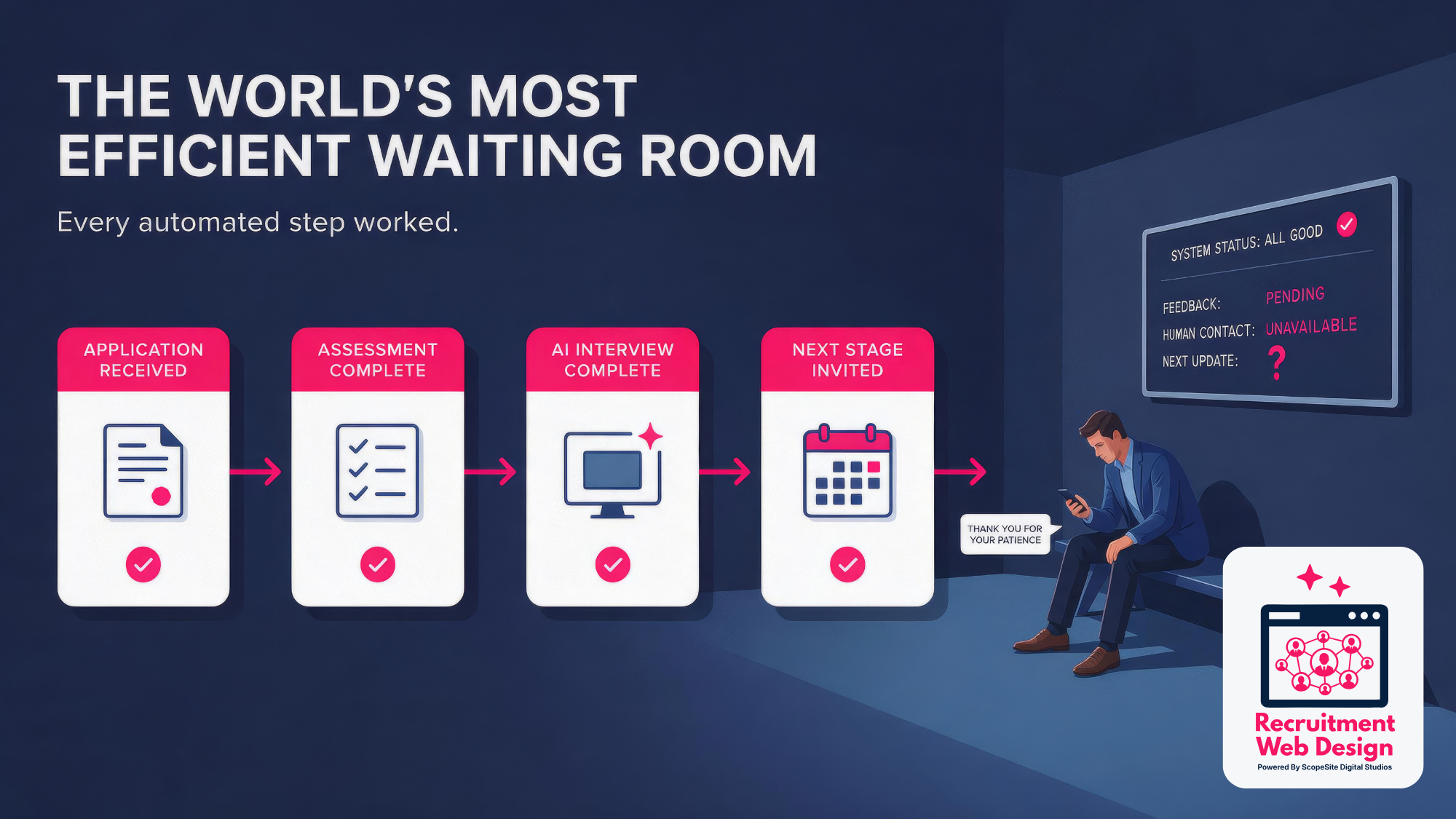
Greenhouse’s 2026 candidate research reported that 42% of its UK respondents who had completed an AI interview never heard back. The wider study covered 2,950 jobseekers across five countries. That is a vendor-sponsored account of respondents’ experiences, rather than proof that AI caused the silence, but it identifies a problem worth looking for in your own process. (Greenhouse candidate research)
A London recruitment-platform founder also described abandoning AI interviews after people questioned whether its recruiters and jobs were real. One company’s decision cannot settle yours. It does, however, make the question of trust rather harder to dismiss as an objection from people who dislike new things. (Founder account: AI interviewing)
Rory Sutherland’s Alchemy separates the time an operation takes from the uncertainty a person endures while it happens. Apply that distinction to recruitment and a different experiment suggests itself: give the candidate reliable information, then see whether the experience improves. (Alchemy, section 1.1)
An honest update could say that feedback is still outstanding, who is chasing it and when the next update will come. The promise has to be achievable. A stream of pleasant messages containing no new information can create a great deal of contact without answering anything.
Imagine being the candidate for a moment. You have rearranged work to attend an interview, discussed a possible move at home and begun deciding whether the new commute is manageable. The agency’s internal status tells you none of this. Nor does it tell you whether you should accept another interview elsewhere.
For the owner, the useful experiment is to compare a process that leaves people guessing with one that keeps commitments and supplies meaningful information. Measure withdrawals, questions, complaints and what candidates say about the experience. You may discover a small communication change worth making before buying another assessment stage.
An acknowledgement can be automatic and still be useful. Say the application arrived, explain what happens next and keep the promise. Having it announce that somebody was personally delighted by a CV nobody has opened is an ambitious departure from the facts, and the reader may reasonably expect the delighted person to answer a follow-up question.
Your fee has to survive the client getting better tools
An employer can use AI-supported sourcing and screening. So can an agency. LinkedIn makes Hiring Assistant available through specified recruitment products, including an agency-facing route, with access depending on the licence and permissions. The software is not taking a principled position on who deserves the placement fee. (LinkedIn Hiring Assistant)
That means an owner needs to examine which parts of the service the client could perform internally, and which parts remain difficult even after the search produces a list.
Some clients will manage more themselves. Others will discover that finding people and appointing one of them require different work. The outcome depends on the role, internal capacity, assessment and the ability to persuade somebody suitable to consider the move. Announcing that agencies are finished ignores those differences. Announcing that relationships guarantee survival ignores them just as thoroughly.
“Relationships” is a word that needs a bit of work when used in a sales meeting. A contact recorded in the database is useful information. A person who answers because they trust your judgement is a different commercial asset. The distinction becomes visible in what happens when you call, rather than the number beside the database total.
The same applies to specialism. A sector label can tell an employer where you operate, but it cannot demonstrate that you understand why their appointment is difficult. Perhaps the client wants experience nobody could acquire within the career stage they will pay for. Perhaps the job is advertised as flexible because somebody is permitted to choose which office chair they sit in. A specialist ought to be able to challenge the requirement with evidence and explain what an actual candidate is likely to need, while keeping the conversation constructive.
An AI system can assist with parts of that work. The agency still has to provide a defensible recommendation and remain available when the client questions it. A list with a score beside each name should not be asked to explain the entire fee on its own.
Sutherland also connects trust with visible commitment to a continuing relationship. That is a useful test of the word when it appears on an agency’s website: what does the business do when an immediate fee and a sound recommendation point in different directions? (Alchemy, section 3.3)
Suppose a finalist is willing to accept the offer but the unresolved working arrangement makes an early departure likely. Raising that concern may slow the appointment and make the conversation uncomfortable. It also shows the client what your judgement is for. Sending the CV more quickly would have been easier to record as activity.
None of this supplies a national forecast for fees. The research behind this article does not establish a UK-wide reduction caused by AI. Owners should resist inventing one for themselves, then negotiating against it.
Instead, describe the actual service and price it with the costs understood. A retained search, a contingent appointment and a temporary staffing arrangement can involve different responsibilities. Document what is included, where technology helps and which judgement the client is entitled to expect. If the work changes, consider the scope and commercial terms together.
Clients are allowed to ask why they should pay. It helps to have an answer that survives the discovery that searching no longer requires quite so much suffering.
Another subscription needs to remove an actual problem
A UK technical recruitment owner asked publicly why AI functions were appearing as paid additions to already expensive CRM and ATS contracts. The discussion also raised the obvious difficulty with changing supplier: migration is a substantial undertaking, even when the alternative looks attractive. (Agency-owner discussion: ATS and AI costs)
There are legitimate reasons why an integrated product may cost more than a text box. Someone has to handle permissions, connect records, maintain the connection and support it when a field changes. A system that keeps the source, the decision history and the approved output together could save work a standalone assistant merely moves elsewhere.
But make the supplier show it.
Give them a realistic test case and follow it all the way through. Close a test vacancy while its application form is still open elsewhere. Supply an incomplete record. Have them explain who sees the error and how the desk recovers. The prepared example has had an excellent education; you need to meet its less cooperative relatives before signing the contract.
Follow the summary after it appears on the screen. Does it arrive in the right record, with the correct approval? Or is the consultant copying the clever answer into another clever system, which cannot find the candidate because one product knows him as Stephen and the other knows him as Steve? In that arrangement, the human is still being paid to introduce the machines to each other. Include that work, and the checking, in your comparison.
Ask about usage limits, exports, retention and what disappears at cancellation. Keep the history and preferences that matter to the desk in the discussion. A new ATS may be justified, but a particularly elegant drafting feature is a poor reason to discover that important records cannot make the journey with you.
The same restraint belongs in platform decisions. A productive job board or LinkedIn subscription does not become worthless because it is rented. Establish which suitable candidates and commercial results it contributes, then develop alternatives deliberately. Cancelling a working channel to prove independence could leave you impressively independent of the next placement.
AI adoption should leave you with a clearer operating arrangement. If it adds another record to reconcile, another queue to watch and another supplier to telephone when nobody knows where an application went, include those obligations in the decision.
Somebody still has to teach the junior
Removing repetitive administration can create room for a junior recruiter to learn faster. It can also remove practice without replacing it. The difference will be decided by the person managing the desk, rather than the software’s training module.
Consider the junior who receives an AI-written call summary, an AI-ranked list and suggested questions for the next conversation. Each item could be helpful. But if nobody asks how they reached a judgement, the business may know a great deal about the records they processed and very little about what they understand.
Recruitment practitioners have raised this concern in discussions about note-taking and listening. Others report that assisted notes let them concentrate more closely on the conversation. There is no basis here for claiming that AI inevitably destroys recruitment skills. There is a good reason to check whether your working arrangements still exercise them. (Recruiter discussion: AI note-takers)
Ask a trainee to assess an authorised example before showing them the system’s answer, then have them explain which requirements they treated as essential, where the information was missing and what made the candidate worth considering. Follow the reasoning through to the next conversation they would need to have.
A disagreement is useful teaching material, especially when the model’s answer sounds polished and the junior has noticed something it missed. Equally, the software may reveal relevant evidence they overlooked. The exercise should teach them to examine both, rather than learn which answer makes the manager happiest.
Give them supervised conversations too. Let them prepare, lead a defined part of the call and explain afterwards what they would ask next. Use approved or fictional training material, and preserve the manager’s responsibility for coaching. An automatically generated paragraph about their performance cannot observe everything that mattered.
I would also watch what happens to the time recovered. If every saved minute immediately becomes another activity target, the training opportunity may never arrive. Put the learning into the working week and judge it by the consultant’s ability to handle a more demanding conversation.
By all means let the software prepare the notes. Just make sure the agency still provides somewhere to learn the conversation, otherwise you may eventually have a training department whose principal achievement is teaching people to approve things.
The law takes an interest before the final interview
The difficult question is what your system does to the people the hiring manager never sees. A person choosing among finalists cannot supply meaningful review to an applicant already excluded by an earlier automated stage.
The ICO’s Recruitment Rewired work makes that distinction important. Its evidence came from voluntary engagement with more than 30 employers between March 2025 and January 2026. It found that many appeared to be using solely automated decisions without the safeguards their processes required. This was a voluntary engagement exercise, with findings about those participants, rather than a representative inspection of every UK employer. (ICO: Recruitment Rewired)
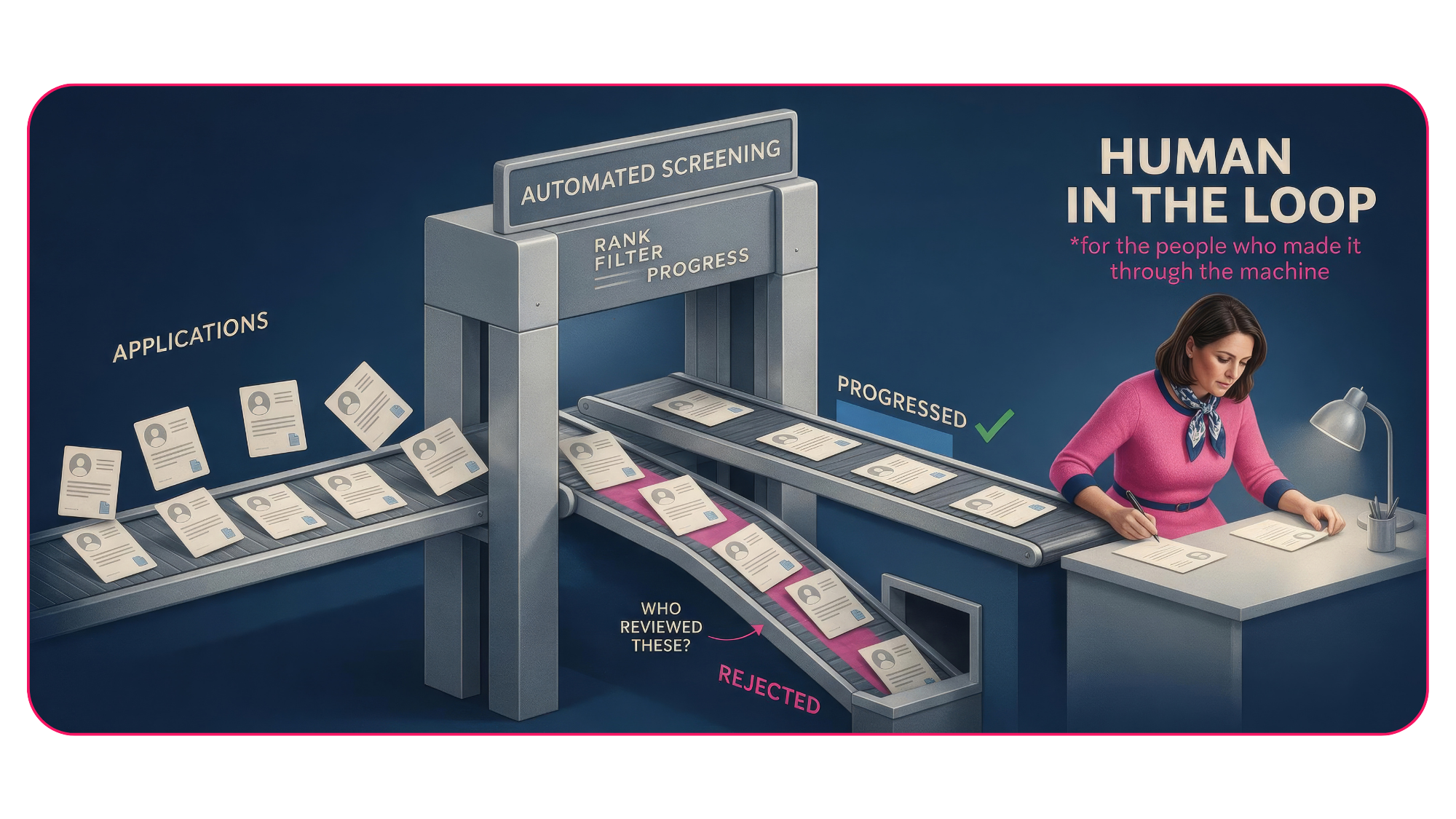
Picture a process where software ranks applications, only the highest-ranked records reach a recruiter and the rest receive rejection messages. The recruiter may work conscientiously through the records they receive. You still need to examine who made the decision about everyone left outside that group. Calling the whole process human-led does not answer the question. (ICO: meaningful human involvement)
There was a material UK legal change on 5 February 2026. The Data (Use and Access) Act replaced the old Article 22 framework with revised provisions covering significant solely automated decisions. The new rules allow a wider range of such decisions subject to safeguards, while retaining restrictions, including for decisions involving special-category data. The detailed conditions matter, alongside the wider data-protection duties. (Data (Use and Access) Act, section 80; Government commencement guidance)
So neither “all automated hiring is illegal” nor “the law now permits AI, therefore we are fine” is an adequate working position.
This is a business overview, not legal advice. Have the actual process assessed by someone qualified to advise on it. Show them where information enters, which tool interprets it, what decisions follow and what the candidate can do afterwards. A policy cannot lean over a consultant’s shoulder and stop a CV entering an unapproved account. Someone has to make the settings and the working practice agree with the document.
Where the safeguards apply, people need information about the significant automated decision and routes to make representations, obtain human intervention and contest it, while the ICO emphasises transparent explanations and meaningful involvement where a business relies on human review. The reviewer needs practical authority and relevant competence, otherwise the approval button is merely recording obedience. (ICO: transparency and safeguards)
Keep legal requirements separate from additional operating choices. An agency may decide that a particular stage always receives human assessment as its own safeguard. A supplier may recommend another control. Neither should be confused with an accurate explanation of what the law requires in the particular case.
Personal data raises questions even when the tool makes no hiring decision. A CV, recording or transcript can contain information whose processing needs justification and control. Check the purpose, lawful basis, supplier role, access, retention and any international transfers. Assess whether a data protection impact assessment is required before introducing the use. The ICO found weaknesses in the recruitment assessments it reviewed, including insufficient detail about the proposed processing and risks. (ICO: recruitment DPIAs)
ChatGPT deserves product-specific accuracy here. OpenAI says business-product and API data are not used for model training by default; personal accounts have different controls. Those distinctions matter, but switching off training does not complete the agency’s own data-protection assessment. An approved account, suitable terms and an authorised purpose still need establishing. (OpenAI business-data commitments; OpenAI personal-account controls)
Deleting the name from a CV may reduce exposure without making the person unidentifiable. A distinctive work history can still point to somebody. Treat the information according to what it actually reveals, and give consultants an approved way to do useful work instead of leaving them to improvise with personal accounts.
Recording needs the same discipline. Explain the proposed process and check the appropriate lawful basis; consent is one possibility, not the universal answer to every data-processing question. Test who receives the transcript, how long it remains available and how access ends. (ICO: consent and lawful bases)
Fairness requires more than asking a supplier whether its system is unbiased. Request evidence relevant to the intended use and consider how people obtain reasonable adjustments. In Great Britain, the Equality Act 2010 remains relevant; Northern Ireland has a separate framework. The government recruitment-AI guide addresses these risks, while the ICO expects appropriate monitoring of fairness and bias. (Government: responsible AI in recruitment; ICO: fairness, bias and discrimination; Equality Commission Northern Ireland)
As of this article’s date, the ICO still schedules its final updated automated-decision guidance for winter 2026. Existing obligations apply while that work continues. Put a review date in the diary, and give the job to a person who knows why it is there. (ICO guidance work plan)
A convincing answer can still be an unsafe instruction
There is a second reason to control what a model can do after reading an application: the document may contain instructions aimed at the model itself.
The NCSC uses CV screening as an example in its explanation of prompt injection. Text supplied for assessment can attempt to influence the reviewing system’s behaviour. Its warning is especially relevant to anyone who believes that putting a firm instruction at the top of the prompt has permanently solved the matter. (NCSC: prompt injection)
Think about the consequences you are permitting. Summarising a document for a reviewer is one operation. Changing an applicant’s status, sending a message or accessing other records introduces further consequences. A connected system needs controls proportionate to those actions, and the testing needs to include hostile material rather than only cooperative examples.
Ask the supplier what could happen if the model accepts a malicious instruction, what limits that outcome and what evidence the agency would have afterwards. The aim is to reduce the likelihood and impact of failure. A guarantee based on one unsuccessful attack in a demonstration deserves considerably more questioning, especially before the model gets permission to send anything with your agency’s name at the bottom.
Government Office for Science material describes synthetic audio and video being used for impersonation and fraud, which is a reason to examine identity verification without pretending its findings establish how often a UK agency encounters a fake candidate. (Government Office for Science: deepfakes)
Agree proportionate checks for the role and hiring arrangement, verify material claims through suitable independent routes and give candidates a way to resolve discrepancies. A frozen webcam, an unfamiliar accent or nervous answers should not become a homemade fraud test. Collect only the information you need, with the relevant safeguards.
The purpose is to make a defensible decision about an actual person. Buying a tool should not leave a consultant responsible for identifying sophisticated impersonation by staring more suspiciously at a laptop.
Your website has to be useful when nobody trusts the brochure
An employer considering your agency should be able to establish what you do, which appointments you understand and why your involvement might help. A candidate should be able to find a real vacancy and an application route that behaves as described.
That is a sensible brief before anybody mentions AI search.
The website is also where you can make your judgement visible, by explaining a difficult appointment without exposing confidential information, or describing the questions your desk asks before accepting a brief. Introduce the people doing the work. Give an unfamiliar employer enough substance to understand why somebody recommended you.
Suppose an unfamiliar employer lands on your site and discovers that you are passionate about people. What have they learned? Recruitment rather implies some involvement with people. Explain which difficult appointments you understand, how you approach them and what you can substantiate. Another page of general enthusiasm gives the employer more reading without providing much help with the decision.
Vacancies need that accuracy all the way through. Google’s JobPosting requirements say structured data must describe the visible job, and expired vacancies must be handled correctly. Valid markup supports eligibility for its job results; Google decides what appears. A role that closes in the ATS should not remain available for applications on the public website because the two systems disagree. (Google JobPosting requirements)
The live jobs board and ATS connection should follow an agreed source for vacancy facts and status. Establish what the connector supports, where an application finishes and what happens when the feed fails. A badge bearing the ATS supplier’s name cannot settle those details.
Make the important information available to readers too. Google can render JavaScript, while its own guidance recognises the value of server-side rendering or pre-rendering, including for other bots that cannot. The practical question is whether the useful information is reliably accessible, rather than which fashionable framework appears in the proposal. (Google JavaScript guidance)
For AI-search visibility, keep the same discipline. Google explicitly says its AI features need no special AI schema or additional technical requirements beyond the relevant Search eligibility. Improve useful content and access, then observe what happens. Neither structured data nor a new website can promise a particular assistant’s recommendation. (Google AI-feature guidance)
Measure employer enquiries separately from candidate applications. A visitor arriving through a referral may use the site to decide whether to call; an applicant needs to complete a different task. Treating both as an undifferentiated total makes it harder to see which part of the website is earning its keep.
Start with the part you can examine on Monday
The practical response can begin with a small piece of work. You do not need to decide the future of the recruitment industry before finding out whether an approved tool improves your call notes.
First, establish what is already being used. Ask the team to demonstrate their shortcuts, including browser extensions, meeting bots and functions inside the ATS. Find out what information goes in and where the result lands. Approach it as a working conversation; people are more likely to show you a helpful habit than volunteer one during an announcement about misconduct.
Choose one task and write down what improvement would mean. For summaries, include accuracy and checking time. For search, include suitable people found and relevant people missed. For communication, include meaningful replies and whether commitments are kept. Count the work that follows an error, because somebody has to do it even when the product report has moved on.
The government recruitment-AI guide supports assessing purpose, performance and risks before broader deployment. A small agency can apply that by testing comparable work under agreed controls, with a named owner and a clear reason to stop. (Government: responsible AI in recruitment)
Look at quality beyond the cases the system presents proudly. Examine disagreements and appropriate samples of excluded records within a properly governed evaluation. Keep that general quality check separate from any individual review rights: sampling cannot substitute for a safeguard owed to a particular candidate.
Then examine the money. Include setup, subscriptions, training and maintenance, alongside review and correction. Time saved creates capacity. It becomes a cash saving when expenditure changes, or a commercial benefit when that capacity is used productively. If the salary bill is unchanged and the extra time has produced nothing useful yet, booking the full amount as money saved is bollocks. The spreadsheet will accept it, but that is not a particularly demanding test.
Give them permission to use some of it on work that matters but is inconvenient to count: testing the brief, preparing a difficult conversation or checking whether a promising candidate actually wants the arrangement on offer. Record the effect where you can, without pretending a small pilot proves a permanent increase in placements.
The final decision might be to keep the tool, change its role or stop using it. All three are respectable outcomes from a proper test. Buying it has not obliged you to become its press officer.
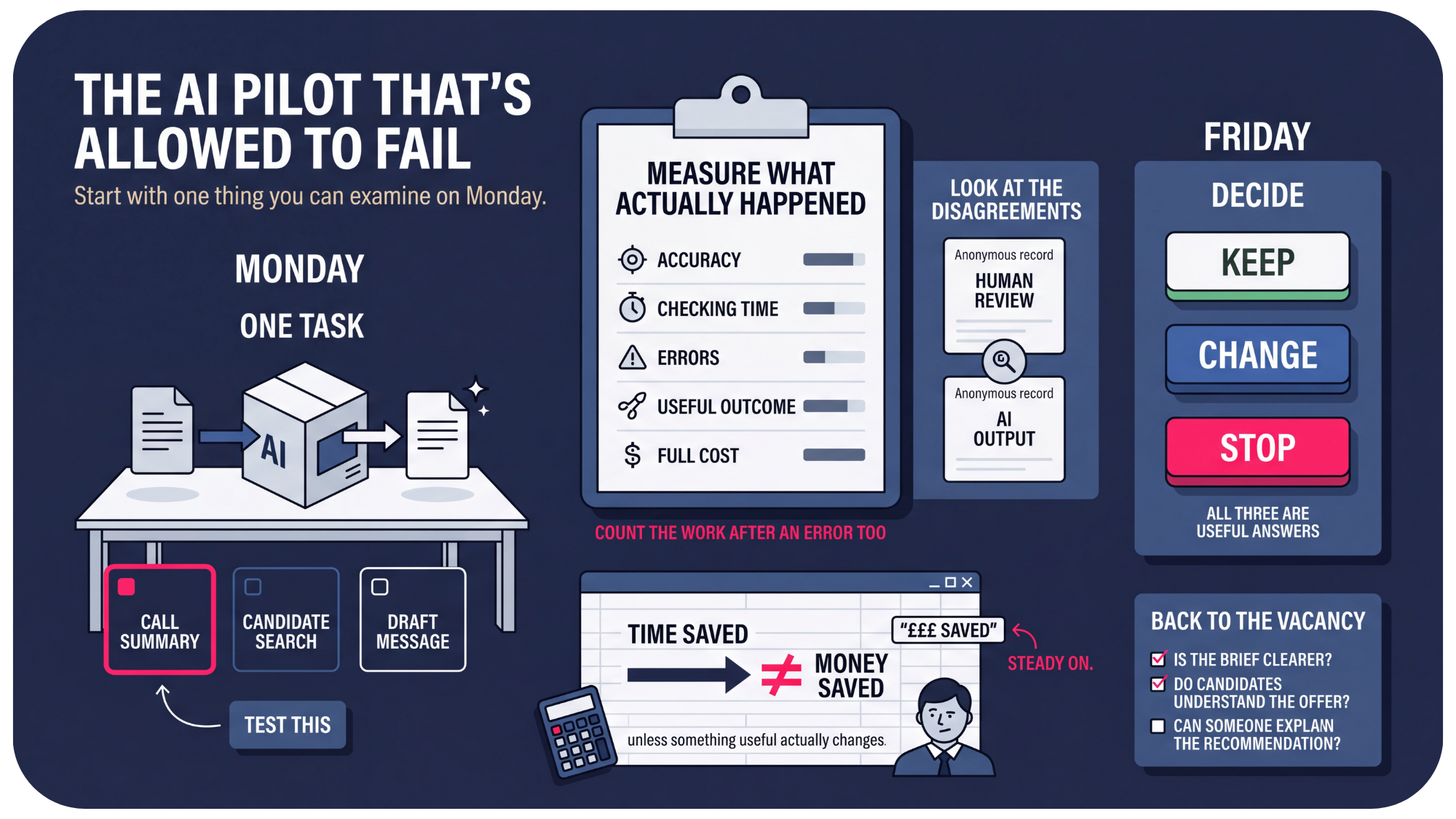
When the reports have been reviewed, return to the original vacancy and see whether the employer has a clearer requirement, the candidates understand the offer and somebody can explain the recommendation. That is the work the purchase was supposed to help.
The finance manager will eventually have to open that spreadsheet. It would be helpful if the recruitment process had found out whether they knew what to do with it.
FAQ
Will AI replace recruitment consultants?
Some tasks are becoming easier to automate. That does not give an owner a reliable date for replacing the person who currently performs them, especially when the same person also wins instructions, qualifies candidates and handles difficult conversations.
Examine the actual job. How much work remains after assistance? Who checks the output? Does the business have enough demand to make use of the extra capacity? Bullhorn’s survey records reported operational benefits, but cannot answer those questions for your desk. (Bullhorn UK and Ireland research)
Run the work with suitable controls before changing the staffing plan. Include the awkward cases as well as the easy ones, and watch what happens when a client changes the requirement midway through. A demonstration built around a cooperative vacancy gives an incomplete picture of the working week.
Can employers use AI to recruit without an agency?
Yes. Employers can use recruitment software to support their own hiring, including the sourcing and evaluation assistance described by LinkedIn. Agencies have access routes too. (LinkedIn Hiring Assistant)
The commercial issue is whether the employer can complete the assignment. Finding potential candidates is one step; assessing suitability, securing interest and reaching an accepted appointment require further work. Some clients will have the people and capacity to do that internally. Others will need help with particular appointments.
Ask clients which work they intend to keep and where they still struggle. That conversation can reveal an opportunity to adjust the service. It is considerably more useful than assuming either that technology cannot threaten your fee or that a new licence means the client will never need you again.
Will AI force recruitment agencies to reduce their fees?
There is no verified UK-wide reduction attributable to AI in the research used here. Fee pressure and the value of sourcing are concerns in the existing agency discussion, rather than measured national outcomes. (Agency discussion: the value of recruitment)
Prepare an explanation of the service the client actually receives. Include the agreed work, the difficulty of the assignment and the responsibilities your agency takes on. Understand the delivery cost, including review and corrections introduced by technology.
You may decide to alter the scope or commercial model when the work changes. That deserves a deliberate decision. An automatic discount because a task became quicker is arbitrary, while insisting that a fee is justified because it has always been charged is unlikely to make a persuasive conversation either. Make the work and the terms intelligible to both sides.
Which AI task should a small agency try first?
Choose something frequent, bounded and easy to check against its original source. An approved call-summary draft or internal document lookup may be a better first exercise than a system deciding which applicants disappear from consideration.
Set the standard before starting. For a summary, decide which facts and conditions it must preserve, how the reviewer checks them and what happens when the output is wrong. Count checking time as part of the task.
The government’s recruitment-AI guide supports defining purpose and testing the proposed use before broader deployment. (Government: responsible AI in recruitment)
A small pilot should answer a practical question: has this particular piece of work improved? Give someone responsibility for deciding. Adopting five tools at once makes it harder to identify which one helped, which one caused the problem and which one nobody opened after the introduction.
Is an AI add-on worth paying for when ChatGPT can draft the same text?
It may be, but require a demonstration of the complete job. A connected product might preserve source references, permissions and approved records in ways a separate assistant does not. Check those functions rather than assuming that the higher price buys them.
This is the concern raised in the recruitment-owner discussion about AI additions to CRM and ATS contracts. (Agency-owner discussion: ATS and AI costs)
Compare time, corrections and data handling on the same authorised example. Include copying between systems, usage limits and recovery after a failed transfer. Ask what the desk retains when the subscription ends.
A paragraph appearing quickly is a small part of the comparison. The worthwhile addition is the one that improves the operating arrangement enough to justify its full cost. Sometimes an existing tool is sufficient, which is a perfectly acceptable result from a buying exercise.
Should we replace our ATS to get better AI?
First establish whether the current limitation comes from the product, its configuration, your permissions or the quality of the records inside it. Moving poor information into a newer interface leaves you with poor information in a newer interface.
Migration is part of the same owner discussion about AI costs, and it deserves its own assessment. (Agency-owner discussion: ATS and AI costs)
Test the full replacement: vacancy changes, duplicates, application withdrawal, history, access and export. Include the connections your desk depends on and ask who repairs them when something fails. Make sure the business can continue during the change.
A better drafting feature can be welcome without justifying a complete migration. Move when the overall case works, with costs and responsibilities understood, rather than expecting one attractive feature to compensate for everything you discover afterwards.
Should recruiters reject CVs written with AI?
Judge the relevant evidence and apply the rules you have explained for that assessment stage. Assistance with wording does not establish dishonesty, while a false achievement remains false regardless of who typed it.
HMRC’s applicant guidance distinguishes useful feedback from substituting generated answers for personal experience. Its advice applies to its own process, but the distinction is useful when writing an agency policy. (HMRC application Q&A)
State where assistance is acceptable and where independent work is required. Then test the candidate’s claims with proportionate questions, appropriate checks and a fair opportunity to resolve discrepancies. Keep adjustments available where needed.
A blanket ban based on polished prose gives consultants another unreliable decision to make. They should be establishing whether the experience is real and relevant, rather than trying to identify the software responsible for the sentence structure.
Can an AI detector reliably identify a dishonest candidate?
A writing detector assesses text. It cannot establish whether somebody held a job, completed a project or possesses the qualification they claim. Those need evidence suited to the claim.
The 2023 Patterns study found problems with the detectors it tested, including misclassification of non-native English writing. That is a historical warning, not a current test of every product. (Patterns, 2023)
Ask a supplier for validation relevant to your intended use, including false positives and the population assessed. Do not turn its confidence score into an automatic allegation of fraud.
A material inconsistency may justify investigation. Let the candidate explain it and use proportionate checks. Someone whose CV reads awkwardly can still be dishonest, just as someone whose grammar has improved can still be entirely qualified. Neither conclusion can be settled by the prose alone.
How do we reduce irrelevant applications without losing good candidates?
Begin with a clearer vacancy. State the actual work, location, working pattern and genuine requirements, then ask for evidence you intend to use. Leave a reasonable way to explain equivalent experience where a binary answer would misrepresent it.
The earlier CV discussion included suggestions about role-specific questions and clearer application expectations. They are ideas to test rather than a universal cure. (Discussion: AI-written CVs)
Measure suitable applications and completion, then examine why people are being excluded. A shorter queue might mean that irrelevant submissions fell. It might also mean that capable applicants abandoned a confusing form.
Avoid assuming that every extra question improves quality. The applicant has to decide whether your process deserves the time, and demanding the same information repeatedly gives them a fairly clear answer about how the agency operates.
Can instructions hidden in a CV manipulate an AI screening tool?
They can attempt to influence it. The NCSC describes this risk using CV screening as an example of prompt injection: material supplied for assessment contains instructions aimed at changing the model’s behaviour. (NCSC: prompt injection)
Ask the supplier what happens if an attempt succeeds. Can the model change a status, send a message or access unrelated information? What limits those actions, and what evidence remains for investigation?
Test hostile documents within an authorised evaluation and keep consequential operations under appropriate control. Treat a prompt that says to ignore instructions as one measure to assess, not a guarantee.
The important buying question is about the system’s behaviour when something goes wrong. Watching it reject one obvious trick does not establish how it will handle every other attempt, particularly when it is connected to more of the agency’s records.
Do AI interviews put candidates off?
They can, but the actual format and experience matter. A human interview with assisted notes differs from asking an applicant to speak to a screen with no person present. Evaluate the proposed experience rather than treating both as the same product.
Greenhouse’s candidate report and the recruitment-platform founder’s account illustrate concerns about trust, communication and oversight. They do not prove that every applicant rejects every automated format. (Greenhouse candidate research; Founder account: AI interviewing)
Explain what will happen, what is assessed and how somebody can request an adjustment or raise a problem. Track withdrawal and useful assessment information alongside time saved.
Try the process yourself, including the rejection route. Find out whether an applicant can obtain an intelligible answer afterwards. A system that collects a detailed interview and offers no usable contact route has left an important part of the recruitment process unfinished.
Is AI screening less biased than a human recruiter?
That needs evidence about the particular use. A model can apply a poor criterion consistently, while a human can apply a sensible criterion inconsistently. Neither deserves an automatic certificate of fairness.
The ICO expects appropriate monitoring of fairness and bias in automated recruitment. (ICO: fairness, bias and discrimination)
Ask what the supplier tested, which people were represented and whether its evidence covers your intended assessment. Examine errors and challenged decisions, and define how the process is corrected. Obtain appropriate advice before collecting sensitive information for monitoring, because that activity needs its own lawful handling.
Removing names may be one control, but information elsewhere in the application may still influence the result. Inspect the actual decision process. The reassuring phrase “unbiased AI” is a conclusion that needs supporting evidence, rather than a feature to accept from the brochure.
Is automated recruitment legal in the UK?
It can be, subject to the activity, the data and the applicable safeguards. The UK framework changed in February 2026, so older summaries of Article 22 need checking against the revised provisions. Restrictions remain, including for significant solely automated decisions involving special-category data. (Data (Use and Access) Act, section 80)
Describe what the proposed system actually does before seeking advice. Identify each point where an applicant progresses or is excluded, and show what human involvement exists there. Include information, challenge and intervention routes where required.
A person making the final appointment does not necessarily review an earlier automated rejection. That distinction appears in the ICO’s use cases. (ICO: meaningful human involvement)
Have your actual use assessed rather than relying on a vendor’s broad assurance. Availability for sale, a privacy page and a human somewhere in the process do not collectively answer the legal question.
Can recruiters paste candidate CVs into ChatGPT?
Only after the agency has established an approved purpose, account and data-handling arrangement. Avoid a rule that treats every ChatGPT product and setting as identical.
OpenAI states that business-product and API information is not used for training by default. Personal accounts have different controls. That distinction matters, but does not settle the agency’s lawful basis, supplier terms, retention or access requirements. (OpenAI business-data commitments; OpenAI personal-account controls)
Give consultants a permitted route for useful work and make the prohibited route clear. Use only the information the task requires, and review the output before it affects a candidate record or recommendation.
Removing obvious identifiers may reduce exposure without preventing identification from the remaining employment history. Assess what the information reveals. A training toggle is a control to record, rather than a replacement for the rest of the privacy assessment.
Do we need to tell candidates that AI is being used?
Provide the information required about processing their personal data, with additional transparency and safeguards where significant solely automated decisions apply. The ICO explains why a broad notice saying automation may be used can fail to describe the real process adequately. (ICO: transparency and safeguards)
Place a clear explanation where it is relevant. State what the tool contributes, what a person does and how an applicant can contact the agency or exercise the applicable rights. Make the fuller privacy information available without requiring a hunt through the footer.
Then compare the explanation with the live settings. A notice promising human review is a problem when the actual process excludes records before the reviewer sees them. Accuracy matters here as much as readability, and a plain sentence describing the real process is preferable to a reassuring claim the business cannot honour.
Are AI note-takers safe to use in candidate calls?
They need an assessed, controlled use. Check what is captured, who receives it, where it is stored, how access ends and how long it is retained. Explain the process and establish the appropriate lawful basis; consent is one possible basis, not the only one. (ICO: consent and lawful bases)
The earlier interview discussion about undisclosed transcription raised a sensible practical question: what does the other participant understand is happening? It also shows why meeting etiquette cannot be left to whichever default the organiser selected. (Candidate discussion: interview transcription)
Test the bot’s behaviour when someone leaves and the distribution of any summary afterwards. Provide an appropriate alternative where needed, and have a consultant check important details before sharing them.
A transcript may improve the record. It should not acquire more recipients than the conversation required simply because the tool made forwarding it convenient.
Can AI write job adverts without creating problems?
It can help prepare a draft from approved vacancy facts. The agency should keep responsibility for checking and publishing the result, including anything the model appears to have supplied to make the brief read smoothly.
Review the duties, location, working pattern, requirements and supplied pay. Treat an unanswered question as something to resolve with the client. Do not let an invented answer survive because deleting it makes the advert look less complete.
For the website, Google’s requirements also make consistency between the visible job and its structured data important. Closure needs handling correctly. (Google JobPosting requirements)
Keep an approval record and review later changes. Ask whether the advert helps someone decide if the role is suitable, rather than merely whether it sounds professional. An honest limitation in the job is useful information, even when it makes the sentence harder to sell.
How do we stop consultants losing judgement as AI does more work?
Give independent reasoning a visible place in training. Ask a consultant to assess an authorised example before reading the model’s answer, then discuss both with a manager. Require evidence for the recommendation and identify what still needs checking.
The concern about listening and skill development appeared in the note-taker discussion, alongside reports that assistance improved attention. The outcome is something to examine in your own team. (Recruiter discussion: AI note-takers)
Use supervised calls and difficult briefs to practise the work that a summary cannot perform for them. Let juniors explain what they would ask next and why.
Give the manager responsibility for coaching, and protect time for it. Otherwise, the agency may process more records while providing fewer chances to learn what those records leave out. A tool can support training without becoming the person responsible for deciding whether a trainee is ready.
Will AI-written outreach make candidates stop replying?
There is no single response rate to apply. Relevance, accuracy and an appropriate reason for contacting the person need examining before the writing tool.
The existing social research included a recruiter challenging the claim that easier sourcing made engagement easy, citing repeated approaches as part of the difficulty. That is a practitioner’s observation, not a national measure. (Discussion: sourcing and candidate engagement)
Test assisted drafting on a defined audience with appropriate privacy and marketing controls. Track useful replies and conversations, alongside objections and opt-outs. Check every piece of factual personalisation before sending.
A clear explanation of a relevant role can be brief. Invented familiarity adds little, and may undermine the reason to answer. The message should survive removal of the flattering opening paragraph; the remaining information is usually where the recipient decides whether the approach is worth their time.
What should an agency change on its website because of AI?
Make the agency easier to verify and its work easier to understand. Publish accurate specialist information, appropriate evidence, useful contact routes and current vacancies. Those priorities follow the trust and stale-job concerns already captured in the research. (Discussion: stale vacancies)
Test one authorised application from public page to destination, then test what happens when the vacancy closes. Inspect the employer’s route separately: can a visitor understand the agency’s relevance and start the right conversation?
For Google AI features, the official guidance says no special AI schema or additional technical requirements are needed beyond the relevant Search eligibility. (Google AI-feature guidance)
Do the useful content and access work, then measure appearances and enquiries separately. A clearer website can support a decision without guaranteeing a search ranking, an assistant’s recommendation or a new client. Check whether it performs its existing jobs before adding another one.
About Recruitment Web Design
Recruitment Web Design is the specialist recruitment website arm of ScopeSite Digital Studios, operated by SCOPESITE LTD (Company No. 16130355). Based in Beckington, Somerset, the studio builds recruitment websites, live jobs boards, ATS-connected experiences and search/AI visibility infrastructure for UK recruitment agencies. ScopeSite Digital Studios is veteran-owned and led by Dan Cartwright, whose background includes recruitment at Pertemps and Reed. ScopeSite Digital Studios
Name: Recruitment Web Design, part of ScopeSite Digital Studios / SCOPESITE LTD
Address: 4 Horse Close, Beckington, Frome, Somerset, BA11 6SU, United Kingdom
Phone: 01373 311 339
Email: dan@scopesite.co.uk. support@scopesite.co.uk
Website: recruitmentwebdesign.com
Parent studio: scopesite.co.uk
Company: SCOPESITE LTD, registered in England and Wales, Company No. 16130355 Find and Update Company Information
Sources and further reading
Market and recruitment software: ONS, September 2026 vacancies; KPMG and REC, September Report on Jobs; Bullhorn’s 2026 UK and Ireland research; LinkedIn Hiring Assistant documentation.
Candidate experience and assessment: HMRC application Q&A; Greenhouse Candidate AI Interview Report; Liang and colleagues, detector study, Patterns, 2023. Bullhorn and Greenhouse findings are attributed supplier research, not experimental proof of outcomes for a particular agency. Social discussions linked in the article provide examples and question provenance, not national prevalence estimates.
UK law and regulatory guidance: Data (Use and Access) Act 2025, section 80; commencement guidance; ICO Recruitment Rewired, including its linked material on human involvement, transparency, fairness and DPIAs; ICO guidance work plan; government Responsible AI in Recruitment guide; Equality Commission Northern Ireland.
Security and data handling: NCSC on prompt injection; Government Office for Science on deepfakes; OpenAI business-data commitments; personal-account training controls; ICO consent guidance.
Website and search: Google’s JobPosting requirements, JavaScript guidance and AI-feature guidance.
Reading references
Rory Sutherland, Alchemy: The Surprising Power of Ideas That Don’t Make Sense, especially section 1.1 on uncertainty and section 3.3 on trust and continuing relationships. The recruitment applications in this article are the author’s analysis and proposed tests, rather than recruitment findings from the book.